
For the first time ever, I attended an Anzac Day commemoration. Anzac stands for Australian and New Zealand Army Corps, and Anzac Day was initially instigated to honour those who fought at Gallipoli after landing on its beaches on 25th April 1915. Gallipoli is a narrow peninsula of land in modern-day Turkey, and was the location of a disastrous campaign for the Allies during WW1, which resulted in brutally heavy losses. An Anzac Day dawn service is now commemorated there, too, and is considered a ‘bucket list’ trip for many New Zealanders and Australians. From what I’ve heard, it’s a powerfully emotional experience, also attended by Turks who were once the enemy being fought.
The first Anzac Day was observed as a half-day holiday on 25 April 1916, and got recognised as an official public holiday in 1920. It has since become a whole day public holiday, and expanded to recognise New Zealand service men and women who have played a part in wars since the Boer War (1899-1902). It’s a day to reflect on the sorrow and cost of war, and pay homage and remembrance for those who have served, and have died. Whilst peace is what the vast majority of us desire, we also have to recognise that wars happen, and defence is necessary. Unfortunately, we humans are simply never not going to bicker and squabble, which inevitably results in conflicts to a greater or lesser degree. It doesn’t mean that we don’t strive to have no wars, but neither can we ignore reality, even if we prefer to.
On Anzac Day, services and commemorations begin at dawn and continue throughout the morning around the country. After a drop off in public attendance during the early part of the second half of last century, particularly with the hostility towards the Vietnam war, attendee numbers began increasing again gradually from the 1980s. Thousands are said to have attended the main dawn service in Cathedral Square in Christchurch today.
At the seaside suburb of New Brighton, where I went for the 10am commemorative ceremony, I estimate that around 1,500 were there. It began with the New Brighton Silver Band leading a parade to the small amphitheatre on Marine Parade, where the Cenotaph stands at the top of the stairs. My father played the Double B Bass in the New Brighton Silver Band for years, and for as long as I can remember it has never been counted amongst the elite bands – lol! But, who cares – it has been around since 1890, so clearly offers more than a desire for prestige to its members. Following the band were army cadets, fire brigade, Girl Guides, and Scouts, and some high school students, all organised by the local RSA (Returned and Services Association).
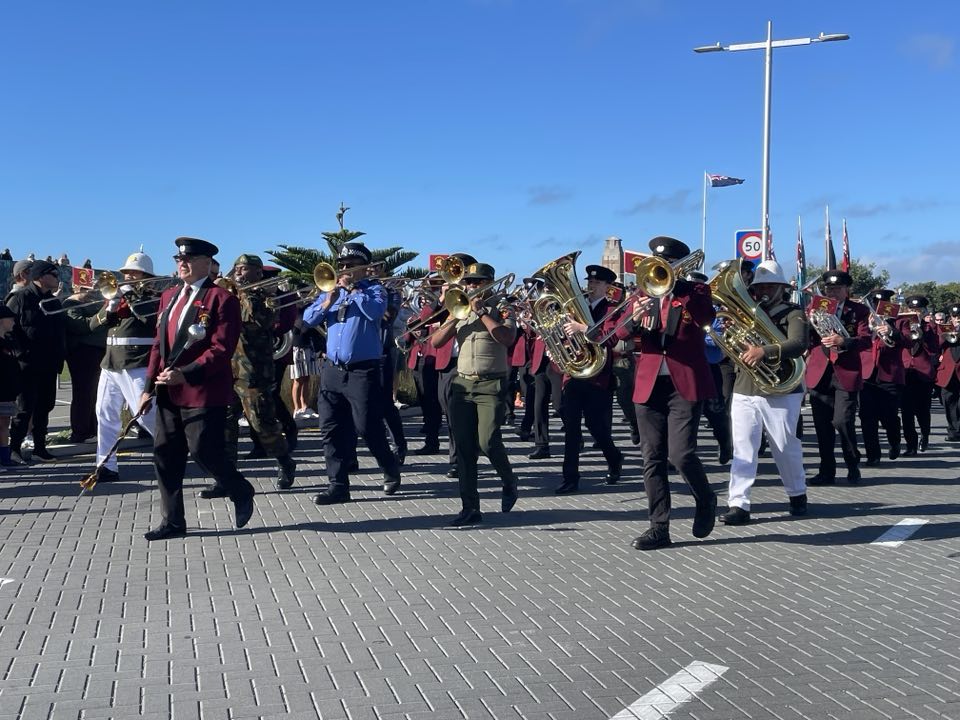
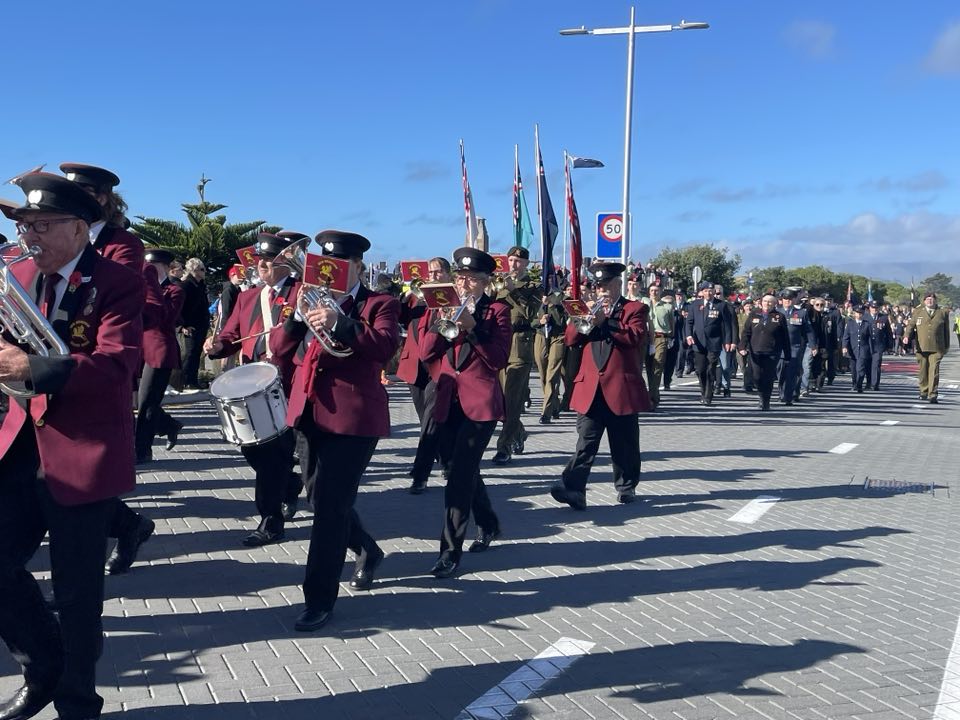

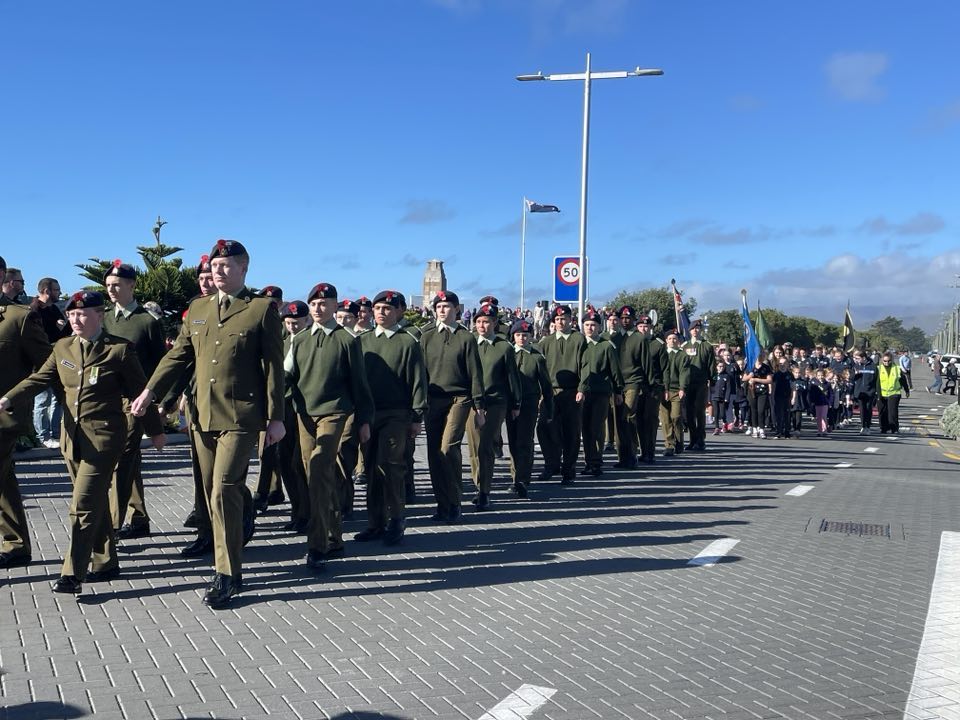
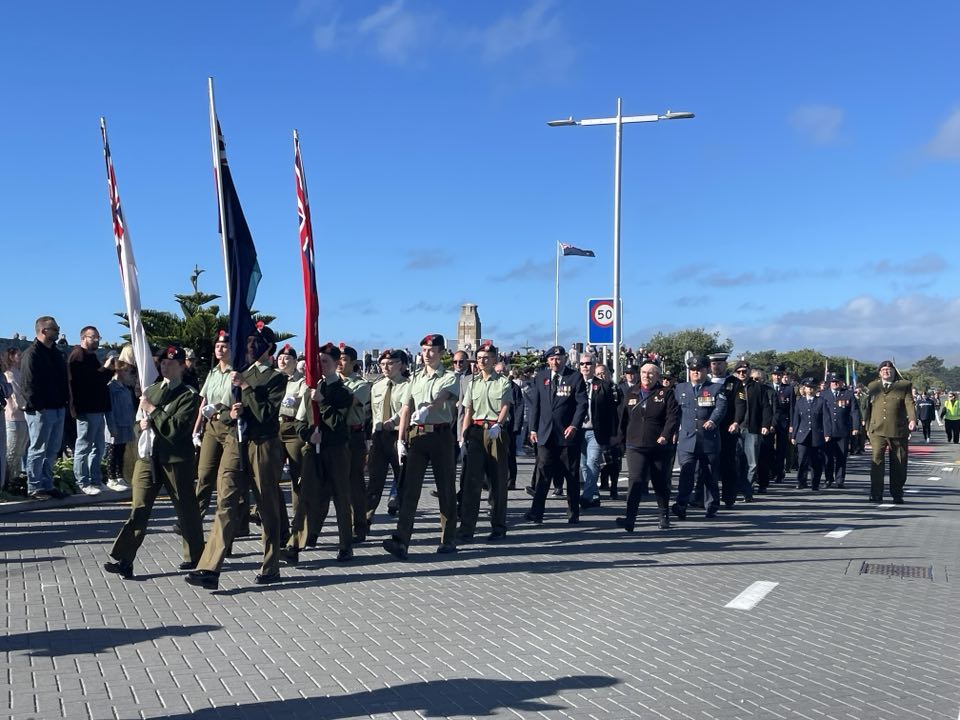

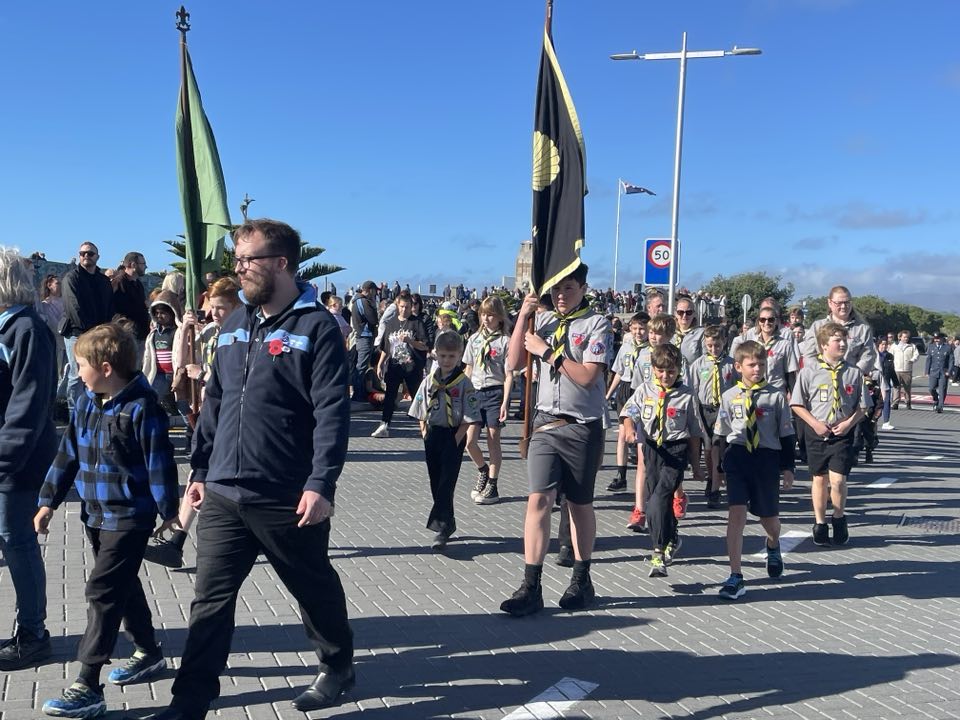
At the start of the commemoration the band played God Save the King, and no one scoffed or booed. The speeches came next, which took about twenty-five minutes all told. These included one from Reverend Katrina Hill, which included the Lord’s Prayer. Again, no one scoffed or booed, with many reciting it along with her. After that came the wreath-laying at the foot of the Cenotaph, and concluded with the Last Post, and then the national anthem in both Māori and English, as has been the custom for some time.
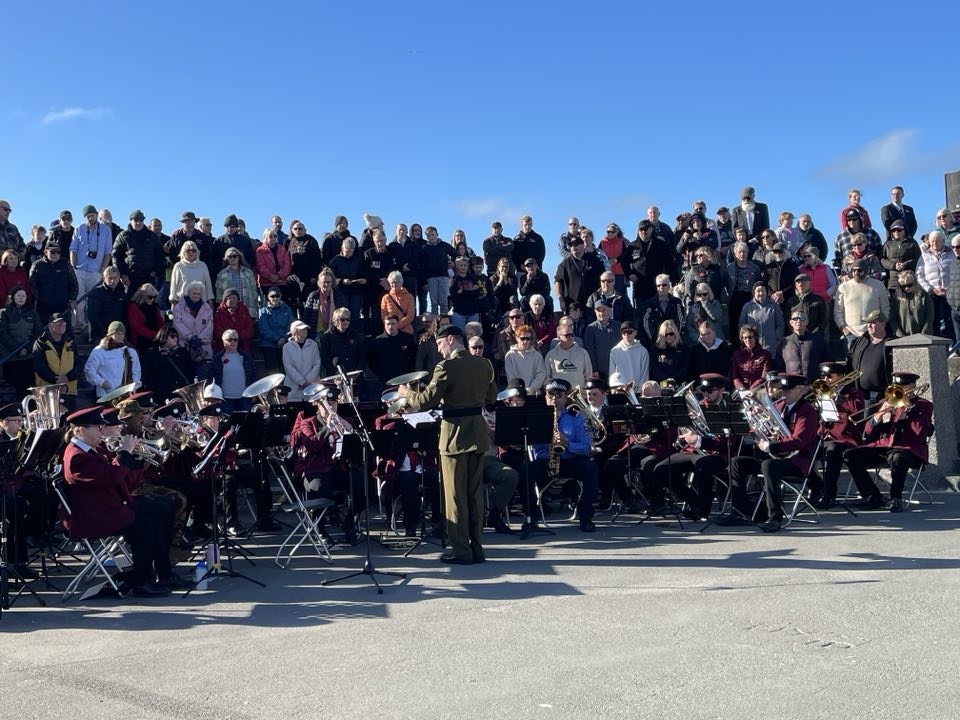


Pic 1: The band with some of the crowd behind it
Pic 2: The Cenotaph with soldiers around it, and flag-bearers on the steps
Pic 3: The Last Post player on the R/H side, and the flags lowered
I admit it felt peculiar to be willingly participating in a conserved tradition again, but also strangely relaxing. The part of me which had moved away from it in my youth, found itself making a strange kind of peace with the comfort of the foundational nature of it. I have acknowledged for some time that the solid foundations in place when I was young are what enabled me to rebel against them in safety. At the time, I thought I was part of creating a whole new world, and those kinds of foundations would no longer be required. Ah – callow youth, eh? But what is youth for, if not to test and push, take risks, and be bonkers 😊 Now, although I may still not be immersed in conserved traditions, I have the awareness they offer us something important not to be sneered at. And bonkers is not necessarily reserved only for youth.
To be honest, I’m still processing the feelings that today conjured up. It’s good, though, and more welcome than not. I expect I’ll go to more Anzac commemorations, as for me, there’s a kind of unexplained ‘magic’ about it all, and if I never fully understand it, and it sounds a bit mad, that’s okay.
 A B'Old Woman
Is it really a conservative tradition? I thought it was about remembering the people who gave up their lives for our freedom. That’s cross-party political isn’t it? Both my grandfathers fought in the war and my great uncle died at Gallipoli. I always think of them and what they did for us.
LikeLiked by 1 person
Ah – maybe conservative wasn’t the best word to use. I didn’t think of it in a political context when I used it, but more in the manner of a conserved tradition. I’ve changed it to that now – thanks 🙂
LikeLiked by 1 person
That makes sense.
LikeLiked by 1 person